Finally
a book and software that makes preliminary aircraft design easy.
The
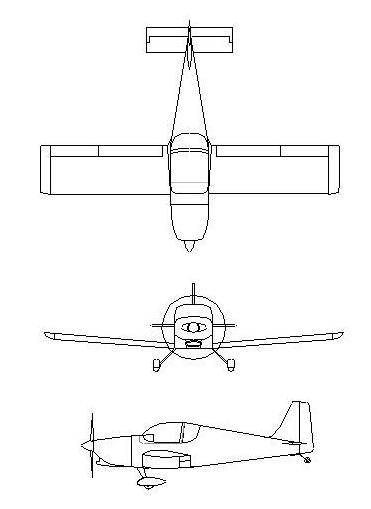
JayBird RX-2 Conceptual Airplane - Follow step by step through
the preliminary
design phase of this airplane.
My Preliminary Design Spreadsheet is now available!
The journey began several years ago when I was encouraged to design a real, home built aircraft. While several excellent plans and kits are available, most of them are expensive and I wanted to jump in head first and design my own aircraft.
I was living in the Salt Lake City area and when I began this journey, I spent hundreds of hours scouring books on aerodynamics from the University of Utah's Marriot Library and I spent several hundred $$$ buying books about aerodynamics. When I had questions, I would contact the authors of the books I was studying. Some of the books in the library took me back to pre-WWII days but they are excellent sources of material!
I found out that designing an airplane is about 10% aesthetics and 90% math! I also discovered that as I would go through the preliminary design phase for an airplane and then, if I decided to change one thing, a domino effect made me have to change several other things! This took lots of time and lots of pretty extensive mathematical calculations.
That is when I realized how much easier it would be to put together a spreadsheet. Spreadsheets easily do these mathematical calculations in less than a second, much quicker than I was able to do on my calculator!
By taking time tested parameters for general aviation, light aircraft, the preliminary design phase of designing an airplane is made much easier!
Chance are very good that you already have Microsoft Excel on your computer which is required to run my Preliminary Design Spreadsheet. By loading the spreadsheet on your computer and then following step by step instructions you will be assured that your airplane's control surfaces will be the correct size. You will also learn what many of the performance specifications will be for your airplane.
There are over one hundred lines of information in my spreadsheet! You can use it for as many airplanes as you like. Once you "size" your airplane, you can move on to the rest of the design process!
Computers are only as smart as the information fed into them. Not only do I lead you through entering the proper information into the spreadsheet with step by step instructions, I also help you understand what certain calculations are for and why they are needed.
Some of things my Preliminary Design Spreadsheet will calculate for you are:
- Aircraft weight by calculating the weight of pilot plus passengers, fuel and baggage.
- Wing and empennage aspect ratios.
- Wing loading
- Power loading
- Horizontal and Vertical tail volume coefficients
- Not only are these calculated for your design but they also show you what the optimum specifications are for a safe, stable airplane.
These are just some of the things you will discover about your airplane design.
The spreadsheet is color coded so you can quickly take a glance and know if a number is something you entered or whether it is a calculation made by your computer.
Along with all of this is a handy quick Converter. Your computer will make conversions for motion/power, weights, measurements and volumes! Easily convert kilowatts to horsepower, pounds to kilograms, centimeters to yards, etc.
The Preliminary Design Spreadsheet is designed to be used with single engine, homebuilt aircraft of conventional design. It can be used to design single place or multi-place aircraft, light sport aircraft and ultraiight aircraft! Use it for as many airplanes as you want to design and pay nothing extra!
For a limited time, you can purchase the Spreadsheet for $69.95,,,A regular $99.95 value!
Microsoft Excel is required to use this software.
Preliminary
Design - Modern Aircraft Design for the Non - Engineer explains
the decisions and calculations that must be made to design today's
modern, high performance aircraft. Learn how to size the aircraft,
the wings and the tail surfaces to fit the needs you have in
an airplane. Learn about airfoil selection and how to plot airfoils.
Then, use the powerful software to simplify design calculations.
Illustrations and large 11x14 inch, foldout technical drawings
lead you through the preliminary design and performance calculations
of a two-place sport airplane.
Chapter
One: Aircraft Types
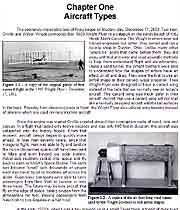 Man
has always dreamed of flying. It all started when the Wright
brothers achieved the unachievable in 1903. Less than seventy
years later, man was walking on the moon!
Man
has always dreamed of flying. It all started when the Wright
brothers achieved the unachievable in 1903. Less than seventy
years later, man was walking on the moon!
In
1986, Burt Rutan and Jeanna Yeager flew non-stop around the
world without landing and without refueling, fulfilling another
seeming unatainable dream.
What
kind of airplane is right for you? There are many different
styles, sizes and shapes of airplanes flying today. In Chapter
One we discuss many of the kinds of aircraft that have flown
and are flying today.
Chapter
Two: Building Materials
The
Wright brothers built the first flying machine from wood and
canvas. Take a look at the different building materials in which
aircraft are being built from today.
Chapter
Three: Setting Your Design Parameters
Design
an airplane that fits you! Learn how to size the cockpit of
your airplane, how to determine the overall size of your airplanes
fuselage and empenage.
Chapter
Four: Beginning the Design: Seating
The
FAA determined long ago that the normal pilot and passenger
weigh 170 pound each. Aircraft of old were designed for small
people. Learn how to design an airplane to fit the REAL sized
human and how aircraft width does or does not affect drag on
an airplane. You may be surprised in what you learn.
Chapter
Five: Airfoil and Wing Placement
What
is the best planform for the wing on your airplane. We take
a look at constant chord, tapered and eliptical wing planforms
and show you the advantages and disadvantages of each.
Chapter
Six: Engine Selection and Placement
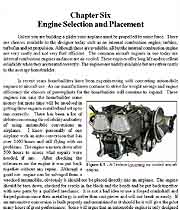 What
kind of engine should you select for your aircraft? How much
difference does horsepower make? We take a look at different
engine types and engine placement.
What
kind of engine should you select for your aircraft? How much
difference does horsepower make? We take a look at different
engine types and engine placement.
We
also take a look at automobile engines that have been converted
for aircraft use. Can this be done safely and effectively? If
the automobile engine is converted correctly, the aircraft owner
will have a safe, powerful, inexpensive alternative for the
air cooled Continental and Lycoming engines that have been the
mainstay of general aviation for the last sixty years.
Chapter
Seven: Wing Planform Design
What
is the best planform for the wing on your airplane. We take
a look at constant chord, tapered and eliptical wing planforms
and show you the advantages and disadvantages of each.
Chapter
Eight: Tail Design
Learn
what "tail arms" are and how the tail arm determines
the size of the tail surfaces on an aircraft.
Chapter
Nine: Completing the Fuselage
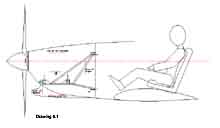 Once
all of the determinations and calculations have been made in
Chapters One through Eight, then it is time to complete the
fuselage drawing of your aircraft. Learn how to easily draw
the fuselage cross sections using CAD software.
Once
all of the determinations and calculations have been made in
Chapters One through Eight, then it is time to complete the
fuselage drawing of your aircraft. Learn how to easily draw
the fuselage cross sections using CAD software.
Chapter
Ten: Landing Gear Design and Placement
Chapter
Eleven: Ten Aircraft
Chapter
Twelve: Wing Bending Moments and Wing Spar Calculations
Chapter
Thirteen: Performance Calculations
Preliminary
Design: Aircraft Design for the Non-Engineer is heavily illustrated
and contains step by step design drawings of the conceptual
aircraft, the JayBird RX-2. Easy to use software allows
you to easily perform the preliminary design and sizing of your
own airplane design! No complicated mathematical formulas to have to
learn!
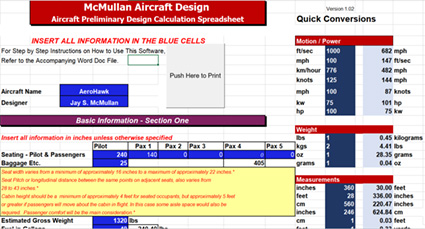
Preliminary Design spreadsheet is available for $69.95.
Anyone who has ever designed and aircraft will tell you that when you change one thing, there is a domino effect and you have to change many things! Using this spreadsheet will help you with that. Just punch in the corrected number and the Excel spreadsheet makes all the other necessary changes to your design. This will save you many hours in your preliminary design phase!
This spreadsheet will help you quickly determine tail volume coefficients, aspect ratio, wing loading etc. It will even give you estimated performance figures!
Step by step instructions are included.
YOU MUST USE MICROSOFT EXCEL TO RUN THIS APP (NOT INCLUDED).
All
information, images, photos, etc. unless otherwise noted are ©
by Jay S. McMullan. DO NOT copy in any form without the written, expressed
permission of Jay S. McMullan and/or his designees. All information contained
on this website or in any publication written by Jay S. McMullan is strictly
for entertainment purposes only! Use at your own risk!